Marco Polo · your China-readiness benchmark

Know your blind spots before they sink your China launch.

A 15-minute readiness benchmark for overseas brands — see exactly where you'll stumble in China, before you spend a dollar entering. Marco Polo scores you against the China-entry standard so you enter with eyes open, not a guess.

Free self-benchmark · No sign-up · You keep the result.

Built on 20+ years of China-entry experience and real market data — since 2003.

Seven-dimension readiness radar showing sample gaps

Spend 60 seconds. Find your blind spots.

Four questions most failed China entries couldn't answer. Be honest — you'll see your gaps instantly.

Can you name the exact Chinese segment (age, city tier, identity) who buys your first 1,000 units?
Do you have ONE hero product chosen for China — not just your global bestseller?
Do you have a Chinese-language feedback loop (RED / Douyin / WeChat) to catch problems early?
Do you have a crisis & compliance plan if you misstep on Chinese social media?
0
blind spots found
Answer the four questions above to see where you stand.

What you get

Your readiness score, a seven-dimension radar, and a clear read of where you stand — benchmarked against the China-entry standard, instantly, before you commit a dollar to China.

Benchmarked score

A clear 0–100 number benchmarked against the China-entry standard, with a traffic-light per dimension.

Radar view

See your strengths and weak spots at a glance — and where you sit vs the benchmark.

Your gap map

See exactly which dimensions you're short on, how wide each gap is, and which way to steer.

Seven dimensions we score

Built from a proven China-entry methodology for overseas brands and products.

Q1 · IncentiveFirst-trial appeal — can Chinese consumers say yes to a first try?
Q2 · Product–Audience FitDo you know which Chinese segment your product serves?
Q3 · Hero ProductIs there one focused product to break through with?
Q4 · Feedback MechanismCan you listen and iterate in the China context?
Q5 · Error PlanWhat's your crisis and compliance safety net?
Q6 · Purchase DecisionIs your content, channel and KOL path mapped?
Q7 · Stakeholder Buy-inIs the owner committed to show up, invest effort, and unblock the team?

How it works

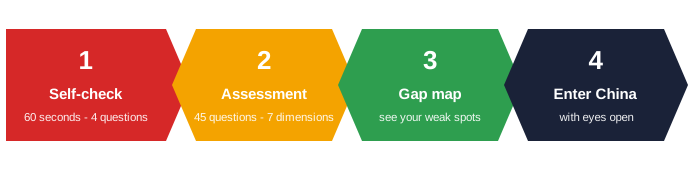
Four steps. No sign-up. You keep the result.

Readiness funnel: self-check to China entry
1

Answer

45 short questions across seven dimensions of China-market readiness.

2

See your score

A 0–100 readiness score with a radar across all seven dimensions.

3

See where you stand

A clear diagnosis of your weakest dimensions — your gap map, not a ready-made plan.

4

Enter China

Take your gap map and your navigated route into the market — or talk to us first.

How Marco Polo helps you navigate the China market

Our benchmark framework is built on two decades of China business entries and the data behind them — since 2003. Most brands don't fail for lack of product; they fail for lack of a navigator. Marco Polo shows you the gaps, the order to fix them, and the way in — whether you go solo, with local partners or agencies, or a combination.

Map your gaps

See the exact cracks across seven dimensions in 15 minutes — before any budget is on the table.

Chart the route

Your gap map benchmarks where you stand vs the standard, and ranks what to fix first, dimension by dimension.

Enter your way

The framework sets you up whether you go solo, with local partners or agencies, or a mix. We can guide the whole route or just your weak spots.

Start free — map your readiness →
Why bother, this early?

Do this now, or pay for the lesson later.

Most China entries don't fail because the product is bad — they fail because the gaps weren't found until money was already on the table. A 15-minute honest self-check today is the cheapest insurance you'll ever buy against a painful, public, expensive launch. Find the cracks now, on a screen — not later, in the market.

The China dream is real

For an overseas brand, China is the ultimate prize — hundreds of millions of digitally-native, trend-hungry consumers; a culture that rewards novelty and shares fast; platforms like RED, Douyin and Tmall that can mint a foreign brand overnight. A successful China entry isn't just new revenue. It's global proof, scale, and the kind of momentum that compounds. The dream is real — and it's worth chasing.

RMB 48.8T
China retail sales of consumer goods in 2024 (+3.5% YoY)
NBS / KPMG
RMB 15T+
Online retail sales — #1 in the world for 12 straight years
China Daily
400M+
Urban middle-income consumers — bigger than most national markets
MFA, PRC
1.1B
Internet users; 1B+ already pay online — commerce is fully digital
CNNIC / gov.cn

But the dream quietly breaks most brands

The brands that fail rarely have a bad product. They skip the readiness filter — and pay for it after launch.

Huge ≠ your market

A 1.4B population means nothing if you can't name your first 2.5%.

No first-trial hook

Curiosity never turns into a first order without a reason to try.

Translated, not adapted

Reads "foreign and irrelevant" instead of "made for me."

No trust signals

Without KOL, certification or a flagship, you're invisible in a high-trust market.

Wrong hero / no fit

The global bestseller flops when spec, story or packaging don't fit locally.

No feedback, no net

You learn the hard way, in public, in hours — with no crisis plan.

21+
Overseas beauty brands exited China in roughly two years (2022–24)
36Kr / Jumeili
13
Beauty brands exited or closed storefronts in just H1 2024
36Kr / Jumeili
≈90%
Of brands going global are estimated to hit a localization disconnect
LianLian Global (est.)
1B+
Chinese pay online — miss WeChat / RED / Douyin and you're invisible to them
CNNIC

Why a readiness filter matters

Most failed China entries aren't mysteries — they repeat the same gaps. A 15-minute filter surfaces them before you pay to find out.

Case 01 · Pricing & channel coherence
A beverage brand hired an agency to enter — before fixing its own house

The brand already had offline presence through a few local shops, but no social media footprint at all. Those shops were selling at inflated prices, so when the official site launched, its own prices looked out of place next to them.

The filter would catch: a broken price-and-channel architecture (Q6 · Purchase Decision) and a missing social base (Q4 · Feedback) — before any agency budget was spent on a launch that looked disjointed on day one.

Case 02 · Stakeholder buy-in
The owner wasn't in it — so the China project stalled

For small and medium businesses the key stakeholder is usually the owner. If the owner isn't interested or isn't fully involved in the China entry, the project will most likely fail — no matter how good the product or the agency is.

The filter would catch: a missing internal commitment signal. Readiness isn't only external — if the person who actually decides isn't bought in, don't burn budget yet. Surface the go / no-go early.

Know your China CAC before you burn budget

A free feasibility tool that estimates customer-acquisition cost from your media plan — and shows how weak brand signals quietly inflate it.

The formula

CAC = (CPM ÷ 1000) ÷ (CTR × CVR) ÷ brand coefficient — media cost divided by funnel efficiency, then adjusted for brand strength.

Brand coefficient

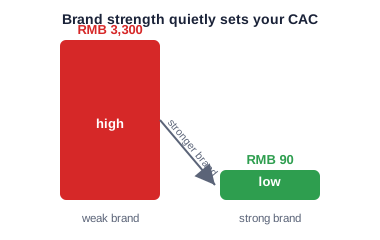
A 0.1–1.0 multiplier. A weak overseas presence (0.1) can 10× your cost; a strong "boomerang" brand (1.0) earns cheap reach.

Reads the verdict

Feasible if CAC ≤ profit per item (first order pays back); moderate if 1–3 items; hard if CAC dwarfs unit profit — fix brand signals first.

Most overseas brands only discover their real CAC after they've paid for it. The calculator flips that: enter your target market size (TAM), core reach, channel CPM, click-through and conversion rates, and it returns an estimated cost-per-acquisition plus the cost to reach your core audience once. The catch is the brand coefficient — it captures how much "education cost" China entry carries. If your cross-border penetration, social position and category share are thin, the model surfaces a steep CAC you'd otherwise learn the hard way. It feeds directly into the CAC feasibility read of your assessment.

Brand strength sets customer acquisition cost
Open the CAC calculator →

Why we built Marco Polo

Two decades of China management consulting, distilled into a tool you can use yourself — before you spend a dollar on bespoke help.

We've been doing management consulting in China since 2003. Across industries and brand sizes, we kept seeing the same mistakes: brands burning budget before they understood their own readiness, then paying again to fix what a simple check would have caught. So we built Marco Polo — tools you can run yourself, first. Instead of selling a bespoke solution at the get-go, we'd rather you benchmark, go through a learning phase, and find out exactly where you want to spend. It saves cost, and it means that when you do engage us, the money goes where it actually moves the needle.

Same mistakes, repeated

Across brands and categories, the failures follow the same pattern — we'd seen them all before building this.

Tools before bespoke

Run the benchmark yourself first. No bespoke engagement is pushed at the get-go.

Learn, then spend

A learning phase shows you exactly where the money should go — so when you invest, it counts.

From assessment to entry

Benchmark your readiness for free — then go deeper with a real market benchmark. When you're ready, we research your actual position against the China market.

Self-benchmark
Free
7-dimension score + gap map. See where you stand vs the standard.
Benchmark Snapshot
Paid
We benchmark you against real brand strength, TAM & CAC feasibility — your score vs the market.
Advisory Sprint
Paid
Focused 2–4 week help on your top gaps.
Entry Engagement
By application
Full localization & entry strategy for qualified brands.
Start free — take the assessment
Free tool: estimate your China CAC feasibility →

Any questions? Feedback? Let's talk.

If you're weighing China entry and want a frank, no-fluff read on your readiness, send a note — I'll get back to you directly.

Get in touch →